
During one of your few windows of free time, you head to your local home store, walk in, and, in a cautiously excited tone, tell an eager employee, “We’re finally redoing our _________ (Insert your long-delayed home project).”
“Great!”, they say. “What are you thinking? What’s the plan?”
And suddenly you’re stammering. You want it to be calmer, more relaxing, but also more energizing and bright. And there’s this thing you saw scrolling the other day. Oh, and that fabric in that one store that time. Uuuu, and the thing you saw on YouTube recently, what was that?!
The struggle is real. But so was the excitement you walked into the store with. Because — somewhere inside — you do know what you want your space to feel like.
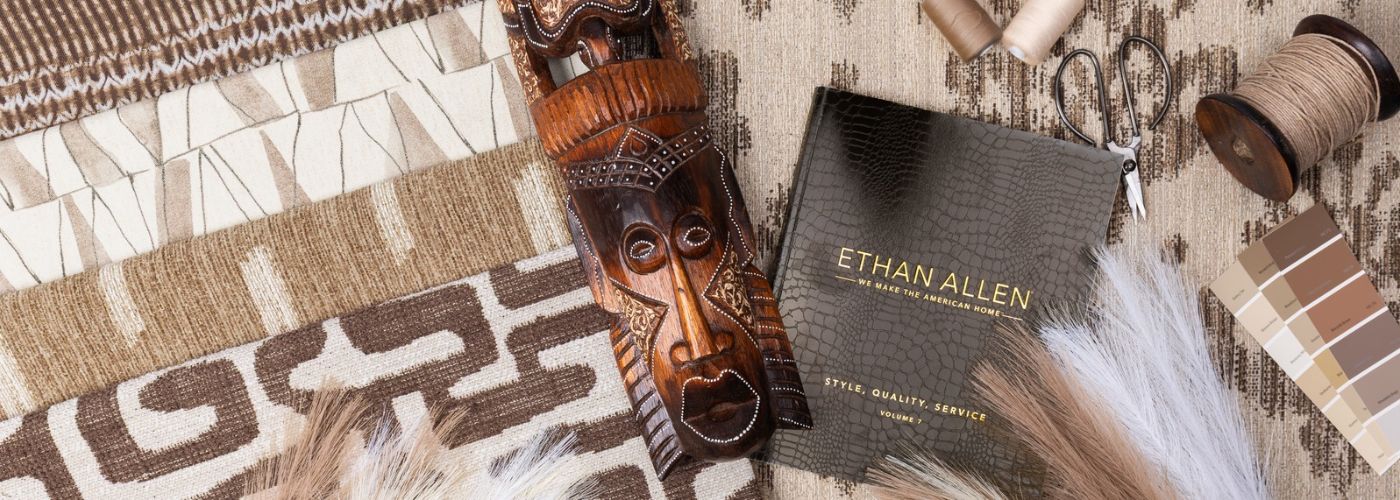
Designers use mood boards to gather looks, textures, and taste, to create before they create. For the rest of us, a mood board is where “This isn’t working” becomes “This is what I really want.” It’s a place to gather those little pulls at your heart, whispers of how you wish your home felt.
Let’s do that.
Start By Collecting The Details That Most Inspire You
Anything can be inspiration. The page from the magazine with the celebrity home you loved. A screenshot of a luxurious hotel or spa. The lighting in your favorite restaurant. That antique chair in your grandma’s house.
In Better Homes & Gardens, mental health therapist and interior designer Annie Guest suggests, “Collect ideas on Pinterest or on a mood board… Your ideas will develop over time.” It doesn’t matter whether there’s a straight line between a lamp you love and a lamp you want by your bed. You’re gathering a sense of things that make you feel some kind of way, letting yourself playfully gather the raw materials.
We sometimes toss around the word “playful” like it means the same thing every time. Let’s be more specific. You don’t have to encounter any of the other scenes above and want the whole thing. But maybe a detail strikes you, moves you in some way. That’s what goes on your mood board.
Designer Michelle Gage simplifies it even more with House Beautiful, “Details, fabrics, or color stories you love are really helpful in understanding what you’re going for.” This first step is curiosity. Taking notes. Collecting clues. Resist the urge to argue with yourself.
Next, Discover Your (Not So) Secret Design Language
Now, let’s sort through your collection, looking for patterns.
Like maybe you notice dark wood paneling, or a particular shade of green coming up time and again. Maybe every sofa you save is big enough to serve as a bed. Maybe you keep finding you gravitate towards velvets.
Suddenly, the pictures and clippings you’ve gathered have become an advanced design tool. Little by little, your mood board is starting to tell you something. Something about you.
Homes & Gardens’ Emma Beryl explains, that’s the path to your design concept, “Notice recurring colors, materials, textures, or shapes, and remove anything that disrupts the overall feeling.”
You start imagining your sofa keeping its lines but warming up its welcome in a caramel plush or small-scale stripe chenille. A reading chair deepens in a rich moss green Crypton velvet. And a round ottoman offers a touch of pattern in an off-white abstract animal print or a classic garden blue and green houndstooth.
It’s less that you’ve learned your own design language entirely, and more like you’ve started to develop your own particular accent. One that will refine and develop as your vocabulary expands.
How One Fabric Swatch Can Unlock Your Whole Design Vision
This is our favorite part, here at the largest online furniture upholstery fabric store. Because this is the stage, fabrics prove to be more than just fabrics.
As designer Nicole Salveson told House & Garden, “We tend to use a fabric as a starting point for a room scheme…it helps to define the look and feel of a space and the colour palette.” Unlike bringing home paint samples and trying to envision a space based on a tiny splash of color, a fabric sample has more to offer like texture, weight, and color — all things that come bearing information.
Like let’s say you find a floral pattern you love, a vintage array of pink, red, blue, and green flowers and foliage perfect for an accent piece. That swatch goes on your board.
Hmmm. There’s a hue in the floral just like a regal rust velvet that would be cool for an upholstered bench. Same for a muted olive green Greek key pattern relaxed woven fabric ideal for your dining chairs. And a soothing cream white boucle becomes a foundational fabric for your sectional.
In case you missed the magic trick, you just pulled four design decisions out of one fabric sample.
Pro Tip: Put fabric swatches where you might use them. Notice how that velvet you love changes from the noonday sun to the evening light — adjust tone and texture as needed. Pillows are another great way to experiment.
Why Design Harmony Sometimes Starts With A Little Disagreement
Mood boards have the wrong name. They ought to be called mood-y boards, because the best ones — the ones with the most personality — are rarely just one mood.
The through-line might be soulfulness, coziness, spaciousness, or a million other shades of you. But, from there, you’re not looking for sameness, like you purchased a room off a showroom floor. You’re looking for colors, textures, and patterns that come together to support the underlying feeling you’re after.
That sometimes comes in surprisingly contrasting, discordant ways. As designer Burcu Ercetin puts it to Apartment Therapy, contrasting materials can feel “unexpected but balanced,” developing a greater impact and luster playing off each other, each adding something different to the design conversation.
The same is true with fabrics. A living room piece in a nubby olive striped fabric offers a neutral, grounding, handmade feel. Paired with a piece in a gloriously oddball ruby red or rich pomegranate velvet, the whole scene takes on an enchanted air.
Unexpected combinations can create a contrast that itself creates a harmony.
Best Laid Plans: How A Mood Board Reveals Your Design Vision
A plan can be helpful. It’s useful to know the steps ahead. But when you’re truly connected to a vision, that’s fuel in your tank. And that’s the gift of a mood board.
Interior designer Vanessa Katzen put it succinctly to Homes & Gardens, “A great board is an archive, not a shopping list.” It reveals what you want your home to feel like. And, at the joyful risk of being a bit esoteric about this, it helps you learn to trust your inner knowing along the way.
From there, you can build the vision a single piece at a time, gradually creating the space you’ve always wanted.
We have all the fabric colors, textures, and patterns for whatever your design vision holds. So move things around. Add something weird. See how it feels in the morning. We’re here to help along the way. Give us a call today.
Links:
Better Homes & Gardens
House Beautiful
Homes & Gardens’
plush
stripe
moss
Crypton
abstract
houndstooth
largest
House & Garden
vintage
rust
Greek
boucle
Pillows
Apartment Therapy
olive striped
ruby
pomegranate
Homes & Gardens
gradually
fabric
help